Our Concrete Services · Kelowna
Professional Concrete Polishing in Kelowna
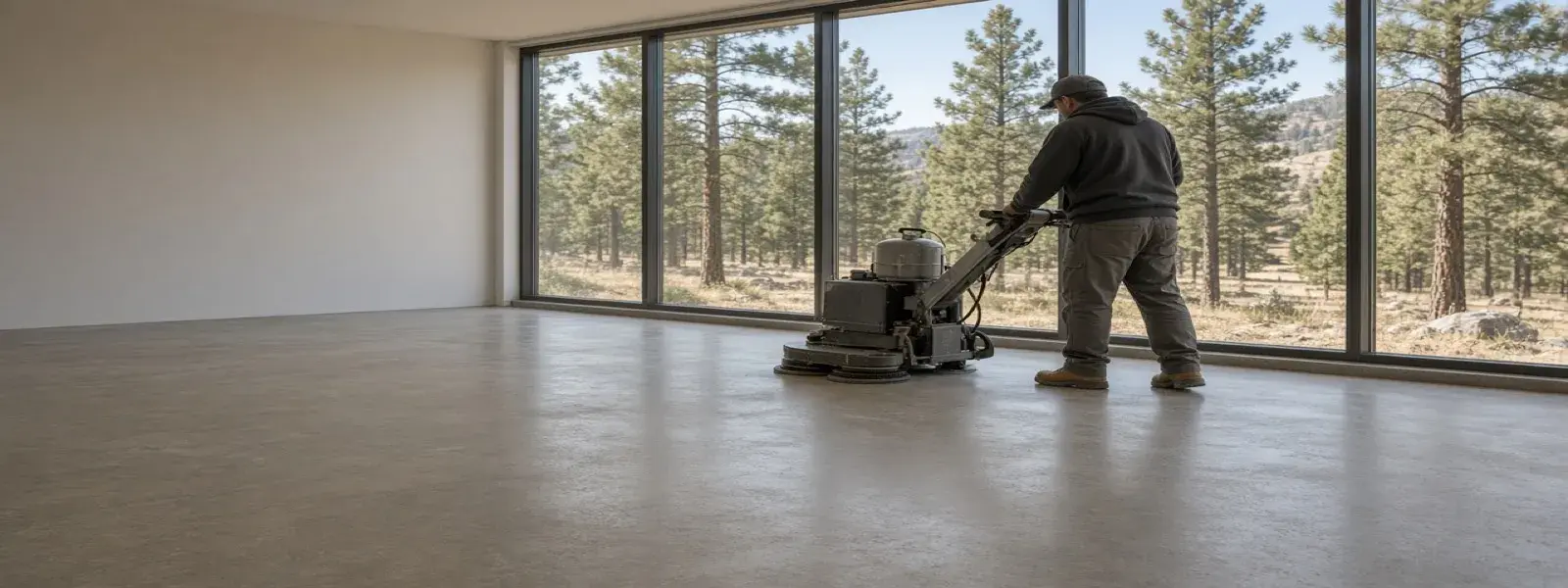
Concrete polishing in Kelowna is a mechanical process, not a coating. We grind the slab with industrial diamonds, densify the paste, and hone it until the floor itself is the finish. There is nothing to peel, yellow, or flake off next July when the Okanagan hits the mid-30s.
Most calls we take are for houses with a tired slab-on-grade, garages that were never meant to stay bare, and commercial rooms where vinyl or carpet has failed. If the concrete is sound, polishing is usually the cleaner long-term floor.
Kelowna Concrete Polishing Pros does this work across Kelowna, the rest of the Okanagan, and on scheduled trips farther out when the floor calls for it.
What people search for when they say concrete polishing
The phrase people type is almost always concrete polishing Kelowna, then a shorter version: polished concrete floors, grind and seal, or honed concrete. They want a smooth, tighter surface that does not dust, and they want it to look finished, not like a warehouse that got forgotten.
Grind and seal is a cousin, not the same job. A grind-and-seal stops early, often around 80 to 120 grit, then a film sealer goes on top. True polishing keeps going through resin-bond diamonds, usually 200, 400, 800, and on up to 1500 or 3000 if you want reflection. We tell you which stop-point fits the room before we start, so you are not paying for a mirror finish in a mudroom.
The grit sequence, and why skipping steps shows
A planetary grinder with metal-bond diamonds opens the floor. In Kelowna we often start at 30 or 40 grit if there is glue, thinset, paint, or a cream-only surface that needs to expose a little fine aggregate. Each pass has to remove the scratch pattern from the pass before it. Jump from 40 to 200 and those scratches telegraph forever, especially under low west light off Okanagan Lake.
After the metal passes, we switch to transitional and resin pads. A lithium densifier goes down once the floor is open enough to drink it, usually after the 80 or 120 metal. The densifier reacts with free lime in the paste and locks the surface so it stops shedding the fine dust you see on bare slabs in garages along Springfield and in older Rutland shops.
The last step is a burnisher with a high-grit impregnated pad, plus a breathable guard if the room sees food, wine, or winter boots. The guard is not a thick film. It is a sacrificial layer you can refresh without stripping the floor back to grey.
How Kelowna slabs behave
A lot of local residential slabs were poured fast during summer construction windows. Hot, dry air pulls water out of the surface, which leaves a weaker cream and sometimes crazing. Those floors still polish, but the first metal pass has to get through that weak skin or the shine will be blotchy.
Hard-troweled warehouse slabs in the north industrial parks are the opposite. They are tight, sometimes over-troweled, and they need a coarser opening so the densifier can actually get in. We test a small patch. If water beads, the floor is tight. If it darkens in a few seconds, it is already absorbent and we adjust the cut.
Control joints stay. Polishing does not erase the saw cuts that let the slab crack where it is supposed to. We can fill joints with a semi-rigid polyurea on commercial floors that see pallet jacks, so wheels do not chip the edges. On a house floor, a colour-matched fill is usually enough.
Honed, satin, or high gloss
A 400-grit hone reads as a quiet, leather-like surface. It hides a bit more day-to-day wear and it is the right call for a kitchen that gets wet. An 800-grit finish is the sweet spot for most Kelowna homes: you see the aggregate, the floor looks finished, and it is not a skating rink when you come in with lake water on your shoes.
1500 to 3000 grit is the showroom look. Retail, tasting rooms, and some new-build great rooms want that reflection. We check slip in the wet zones. A high gloss in a shower transition or an exterior stoop is the wrong tool. Outside, we seal or use a textured overlay instead of a polish.
What polishing will not do
It will not bridge a moving crack or lift a slab that has settled. If a section of floor rocks, or you can see a ridge from heave, grinding can ease a trip lip of a few millimetres. It cannot make a failed subgrade flat. Those spots get a conversation about a topping or a partial replacement before anyone sells you a shine.
It also will not hide a bad mix. If the original pour was full of popouts from soft aggregate, polishing exposes them. Sometimes that looks honest and good. Sometimes the better path is a micro-topping or a stain after a light hone. We say so on site, not after the third pass.
Care after the floor is done
Dust mop, then a neutral cleaner. Skip vinegar, skip citrus degreasers, skip the big-box floor wax. Those products either etch the paste or leave a film that dulls the burnish. Felt pads on chairs matter more than any chemical.
In a house, a re-burnish every couple of years brings the clarity back. In a shop with forklifts, we plan a maintenance hone on the traffic lanes. The body of the floor does not wear out the way a coating does. You are maintaining a surface that is part of the slab.
Questions on concrete polishing
What grit level do you finish polished concrete at?
We typically finish at 800–3000 grit depending on your desired sheen level. A 400-grit hone gives a satin look; 1500–3000 grit produces that reflective, showroom-quality shine most clients in Kelowna homes and commercial spaces are after.
How long does concrete polishing take?
Most residential jobs (500–1,500 sq ft) take one to two days. Larger commercial floors take two to five days. We don't rush the passes — cutting corners on the intermediate grits shows up in the finished shine.
Does polished concrete need to be resealed?
Polished concrete with a penetrating densifier is very low maintenance. A light application of a concrete-specific guard every two to three years keeps it looking sharp. Unlike epoxy, there's no film coating that can peel or chip.
Can any concrete slab be polished?
Most slabs can, yes — but condition matters. Slabs with major cracking, significant aggregate pull-out, or previous epoxy coatings in poor condition may need prep work first. We assess every floor before quoting.
What's the difference between honed and polished concrete?
Honed concrete stops at a lower grit (typically 200–400) giving a matte or satin surface. Polished concrete continues to 800, 1500, or 3000 grit plus a burnishing pass for a high-gloss, reflective finish. Both are durable; the choice is purely aesthetic.
Related concrete work
- Epoxy Floor Coatings Kelowna
- Concrete Grinding & Leveling Kelowna
- Garage Floor Coatings Kelowna
- Concrete Polishing Kelowna
If this is the floor you have, call Kelowna Concrete Polishing Pros and tell us what the slab is doing. We would rather look once than guess from a text.
Call 250-999-2787