Our Concrete Services · Kelowna
Industrial Concrete Floor Polishing in Kelowna
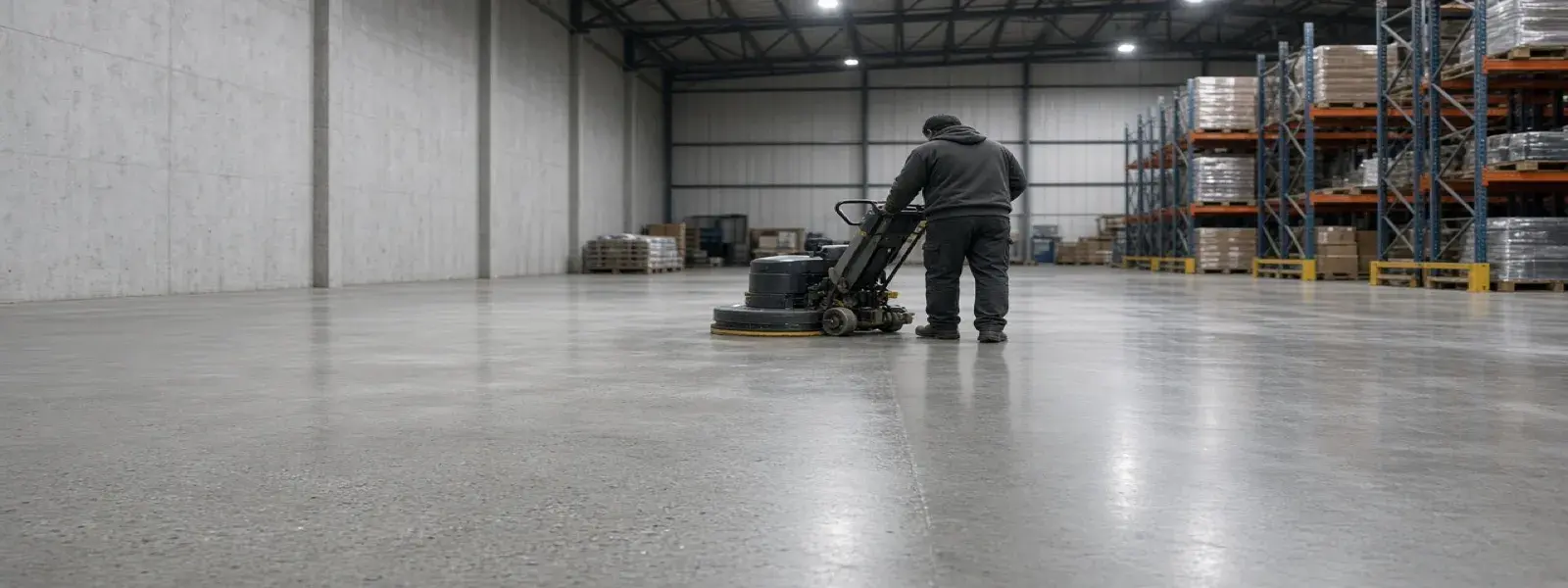
Industrial floor polishing in Kelowna is for warehouses, production rooms, and distribution slabs that have to live under point loads. Paint and thin epoxy look fine on day one and then sheet off under a forklift. A ground, densified floor does not have a film to lose.
The win is dust control as much as shine. A slab that stops powdering keeps product, packaging, and lungs cleaner.
Kelowna Concrete Polishing Pros does this work across Kelowna, the rest of the Okanagan, and on scheduled trips farther out when the floor calls for it.
Why plants move off painted concrete
A painted warehouse floor fails at the tyre path first. You see crescent marks, then bare patches, then a patchwork of recoats that never match. Polishing cuts that cycle. The wear surface is the concrete, hardened with a silicate densifier so the paste does not keep turning into dust on the racking.
Food and beverage spaces in the valley, from packing rooms to breweries, care about that dust. A densified floor is easier to wash down. It is not a magic antimicrobial. You still clean it. You just are not cleaning yesterday's concrete powder out of the corners.
Flatness, FF numbers, and what we can still fix
A grinder improves surface texture and can knock down a joint lip. It does not turn a poorly struck slab into a superflat floor for high-reach turret trucks. If your specification calls for a defined flatness number, that had to be in the original pour. We will measure, tell you what the floor is, and polish it honestly.
Curl at the joints is common on large industrial panels. Grinding the curled edge reduces the bump a pallet jack feels. Filling the joint afterward keeps the arris from blowing out. That two-step is most of the industrial calls we get after the first year of a new building.
Chemical exposure
Densified concrete resists a lot of ordinary shop fluids better than bare concrete, and worse than a purpose-built chemical-resistant coating. Battery charge areas, solvent stores, and some process lines still want a coating or a locally applied resistant top. We do not pretend a polish is a secondary containment system.
Where forklifts and oil are the main event, polish plus a disciplined cleaning schedule beats a coating that will be gouged. Where acids sit, we talk about a different surface in that zone only, so you are not paying to coat the whole building.
Production schedule
Big floors get done in lanes so the building can keep receiving. Coarse grind, vacuum, densify, hone, burnish. We mark the lane that is curing and the lane you can cross. Night work is normal in occupied distribution buildings around Kelowna and up the highway in Vernon.
Lighting in these buildings lies. A floor can look perfect at noon and show scratch patterns under the LED aisles at 6 a.m. We check the floor under your actual lights before we call the last pass done.
Questions on industrial floor polishing
Why do warehouses choose polished concrete over painted floors?
Polished concrete doesn't peel, chip, or delaminate under heavy forklift traffic the way painted or thin-coat systems do. Once ground and densified, the floor is mechanically part of the slab — it won't lift under constant load cycling.
Does polished concrete reduce dust in a warehouse environment?
Yes. Densification chemically hardens the surface, dramatically reducing concrete dusting — the fine concrete particles that standard slabs shed over time and contaminate products. This is one of the primary reasons food processing and distribution facilities in the Okanagan specify polished concrete.
Related concrete work
- Concrete Polishing Kelowna
- Epoxy Floor Coatings Kelowna
- Concrete Grinding & Leveling Kelowna
- Concrete Polishing Kelowna
If this is the floor you have, call Kelowna Concrete Polishing Pros and tell us what the slab is doing. We would rather look once than guess from a text.
Call 250-999-2787